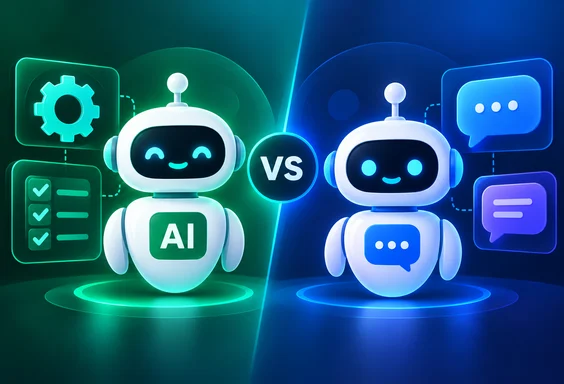
AI agents and chatbots are often used interchangeably, but they are not exactly the same.
A chatbot is primarily designed to communicate with users. An AI agent can go further by using information, tools and workflows to perform tasks.
Understanding the difference can help businesses choose the right solution.
What Is a Chatbot?
A chatbot is a software application that interacts with users through conversations.
A typical chatbot can:
- Answer questions
- Provide information
- Guide users
- Collect basic details
- Direct users to resources
Modern AI chatbots can generate much more natural responses than traditional rule-based chatbots.
What Is an AI Agent?
An AI agent is designed around a goal or task. For example, a sales AI agent could:
- Receive a new lead
- Read the lead information
- Ask qualification questions
- Analyse the responses
- Update the CRM
- Assign the lead
- Trigger an email
That is more than conversation. It is a workflow.
Key Difference
| Chatbot | AI Agent |
|---|---|
| Primarily conversational | Task-oriented |
| Answers questions | Performs actions |
| Usually reactive | Can execute workflows |
| Limited tool access | Can use multiple tools |
| Simple workflows | More complex workflows |
When Should You Use a Chatbot?
A chatbot may be enough when you need:
- Website support
- FAQ answers
- Product information
- Basic lead collection
- Navigation assistance
If the primary requirement is communication, a chatbot can be a practical solution.
When Should You Use an AI Agent?
An AI agent may be more suitable when the system needs to:
- Perform multiple steps
- Access business systems
- Update records
- Analyse information
- Trigger actions
- Coordinate workflows
For example, a recruitment agent could review candidate information, compare it with job requirements and organize qualified candidates for recruiter review.
AI Agents Can Still Have Conversational Interfaces
The two concepts aren't mutually exclusive. An AI agent can have a chatbot-like interface. The difference is what happens behind the conversation.
A chatbot might answer: “Your order is being processed.” An agent could potentially retrieve the order status from the system, identify the current stage and provide the customer with updated information.
Which Should Your Business Build?
Start with the business process. Ask: Does the system only need to answer questions? A chatbot may be sufficient.
Does it need to access systems and perform actions? An AI agent may be more appropriate.
Final Thoughts
The choice between an AI agent and chatbot shouldn't be based simply on which technology is newer. It should be based on the outcome you need.
At KKEYDOS, we help businesses design AI solutions ranging from conversational assistants to task-oriented AI agents and automation workflows.
Not sure which approach fits your business? Let's discuss your use case.